

Direct Action: what is it and why its needed NOW to change the world
Feeling hopeless? Want to demand change? Here's the truth about why most protests fail—and what to do instead!

I’ve noticed something. When the people feel legislative action has failed them, the discussion gets derailed by the following argument: “we have to peacefully assemble!” vs “marching isn’t enough—we need violent revolt!” The conversation then revolves around choosing a side in this binary, as if these were the only two options.
I’ll let you in on a secret: neither marching nor rioting are the way to demand change from those with power. A march or rally are examples of demonstrations. A demonstration is a powerful show of force, but marching alone is merely symbolic. It demonstrates, “look how many supporters we have,” but it doesn’t do anything with those supporters. Sometimes a show of force is enough to scare power to change. But as long as marching is all that is done, the marches can be ignored. The March for Our Lives didn’t stop gun violence, for example, nor did the Women’s March stop patriarchy, despite the historic size of those actions.
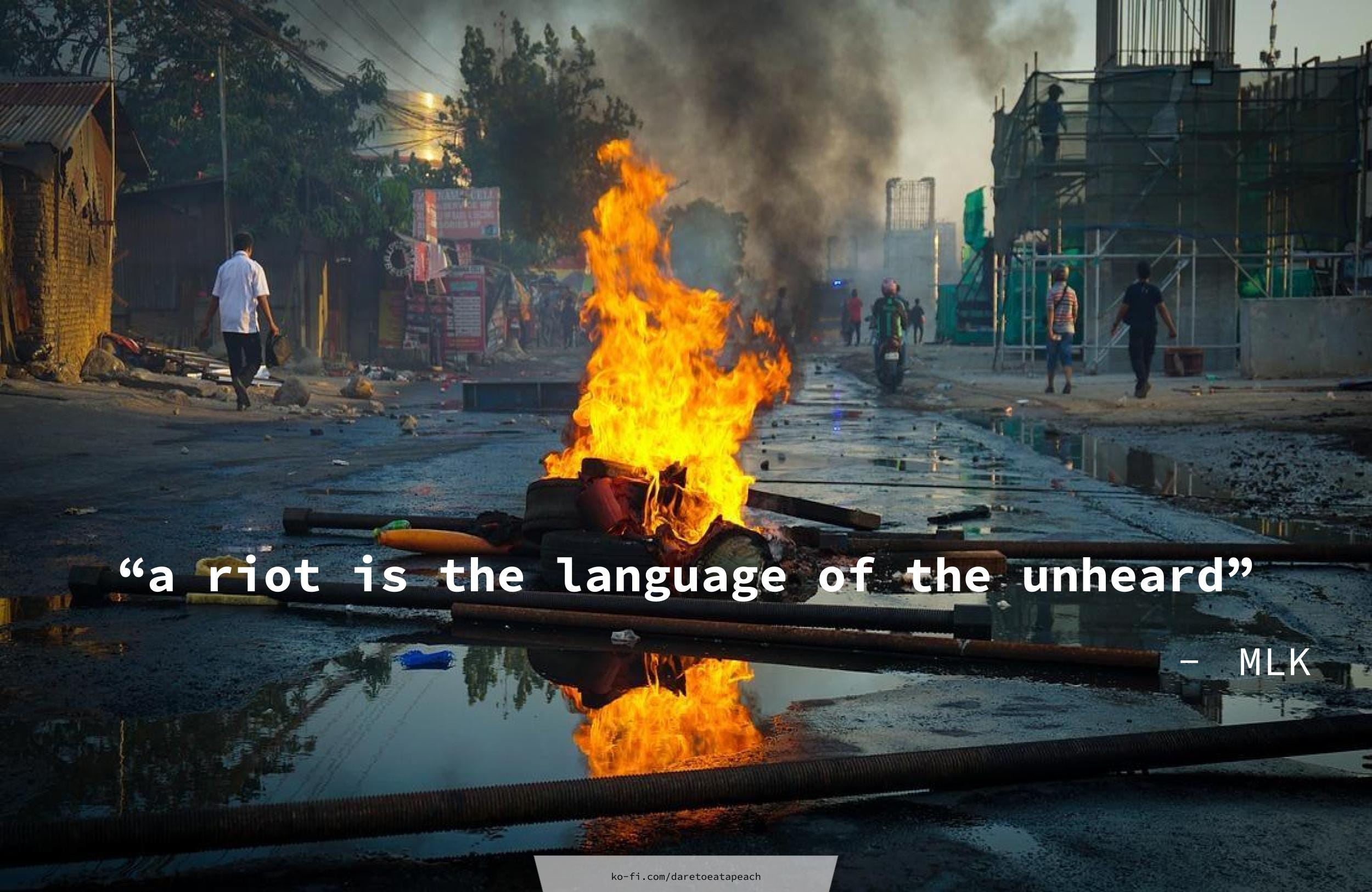
The other side of this debate asserts that peacefully assembling didn’t bring about change, so they reason that the problem was that it was too peaceful. But this is also wrong. Disorganized violence seldom targets those with the power to make change, and it certainly doesn’t hold them accountable.
Rejecting both premises, too many turn to despair and give up hope on improving the world. But there is another way. In fact this other way is what got us most workers rights, from the eight-hour day, to the end of child labor, to desegregation, and more. Most every human right you have comes from this approach to protest organizing. It is called direct action.
What is direct action?
The most elegant forms of direct action involve proceeding as if the world already is the way that the protestor wishes for it to be. But it can also mean standing in the way of injustice taking place. In both instances, the protestors take actions that directly affect the outcome they want.
There is a famous speech from the launch of the Student Movement in the 1960s from Mario Savio describing direct action:
There is a time when the operation of the machine becomes so odious, makes you so sick at heart, that you can’t take part. You can’t even passively take part! And you’ve got to put your bodies upon the gears and upon the wheels, upon the levers, upon all the apparatus, and you’ve got to make it stop! And you’ve got to indicate to the people who run it, to the people who own it — that unless you’re free, the machine will be prevented from working at all!
This is what direct action is all about: not merely expressing your anger, but physically standing in the way of injustice. It’s deciding, we’re not asking for permission. We will shape the world directly.
How direct action overturned an unjust law
My favorite explanation of direct action comes from Utah Phillips, the union history folk storyteller. He recorded an album with 90s folk goddess Ani Difranco, with a track called “Direct Action.” I’ll summarize below, but it’s much better in his words:
In summary: in response to union activists soapboxing, the local government outlawed free speech. So, hundreds of Wobblies took their turn on the soapbox to assert their right to express themselves. Most would be arrested before getting past “Fellow workers!…” The local jail filled up with free speech activists. There was no time or money for the police to prosecute anything but free speech, and no room in the jail for anyone but activists. So the rule had to be overturned.
They did not ask permission or advocate to overturn the law. Instead the workers acted as though it were not illegal to speak freely. And in doing so, the law could not be enforced. But it doesn’t have to mean getting arrested, it doesn’t even have to mean breaking the law (but remember, in an unjust society if you are being effective, they will likely arrest you anyway!).
That’s not direct action! The two types of protest we see plenty of today
It helps in identifying direct action to compare it to what it is not: symbolic or legislative.
Legislative action
Letter writing campaigns, phone calls to congress, citizen lobbying and petitions are all common grassroots tactics that are not direct action. What these tactics have in common is that they all ask permission, relying on politicians to act on their behalf. That’s legislative action: working with the system’s bureaucratic tools to shape the laws. A sit-in on the floor of congress is a more demanding way to ask permission, but it’s still not direct action.
In contrast, in a direct action the protestors act to instigate change themselves. Changing the law is certainly a measure of success, as it indicates the security apparatus of the state is now aligned with the goal. But if you center the goal around the law, you already start by ceding power to someone else. The Wobblies did not write letters to the mayor asking him to overturn the free speech ordinance. Rather they refused the law or its authority to impinge on their human rights.
Symbolic action
I’ve already given the example of demonstrations as typical of symbolic actions. Other symbolic actions include hanging banners, street theater, making memes, street art, or modifying your appearance to indicate support for a cause. Nearly all symbolic action is centered around advocacy.
Direct action does not have advocacy (or “raising awareness”) as its only potential outcome. Many protests start with the premise, “if only enough people knew about this problem, surely change would come.” The interesting times we’re in now prove this is insufficient. Plenty of people are aware of the crisis of climate change and authoritarianism, yet both get worse by the day. For years people thought, “surely this school shooting will be the one that gets people to wake up!” Well we’re all woke now. What do we do about it? Awareness is important, but it’s just the first step.
Please note that I am not saying symbolic or legislative protests are bad. Both have value in the right context. Which brings me to an important point…
We need more direct action, but it’s not the most important thing
If you intend to prevent the cogs from turning, you must understand the clockwork. Demonstrations (or other symbolic gestures) don’t require that understanding. There may be a lot of work that goes into planning a march or rally, but it doesn’t require any strategy. To march all you have to do is decide where to show up and spread the word. Easy! But is it effective?
Direct action requires planning, creativity and strategy. It is the strategy that is key! For an effective campaign you need to have clarity on that clockwork of injustice. Who is profiting from this? Where do those people go to work every day? Not only the people at the top, the day-to-day cogs, also the people “just following orders” and the the people whose jobs affect the injustice in a tangential way.
However, do not think that these complications are disadvantages. On the contrary, these are important questions that every activist should be asking about every action they organize. A rally at the corner of a street that is far from the nexus of power is not likely to be effective.
If you want something done right…
It’s obvious what a march looks like, but direct action, by its very nature, looks different depending on the context. A tactic in one situation would be direct action and in another situation it wouldn’t! If you are still confused about what direct action is; don’t stress about it. Fitting into a rigid definition isn’t as important as having a clear understanding of the dynamics of power. Direct action is a shortcut to making sure your plan is aligned with your objective.
If you’re struggling to plan how you might organize, think about what it is that you want, and what it would look like if you didn’t wait for permission to achieve it. If you said, this changes now, because we are going to do it ourselves. What would you do? What would that look like?
Direct Action: the antidote to despair
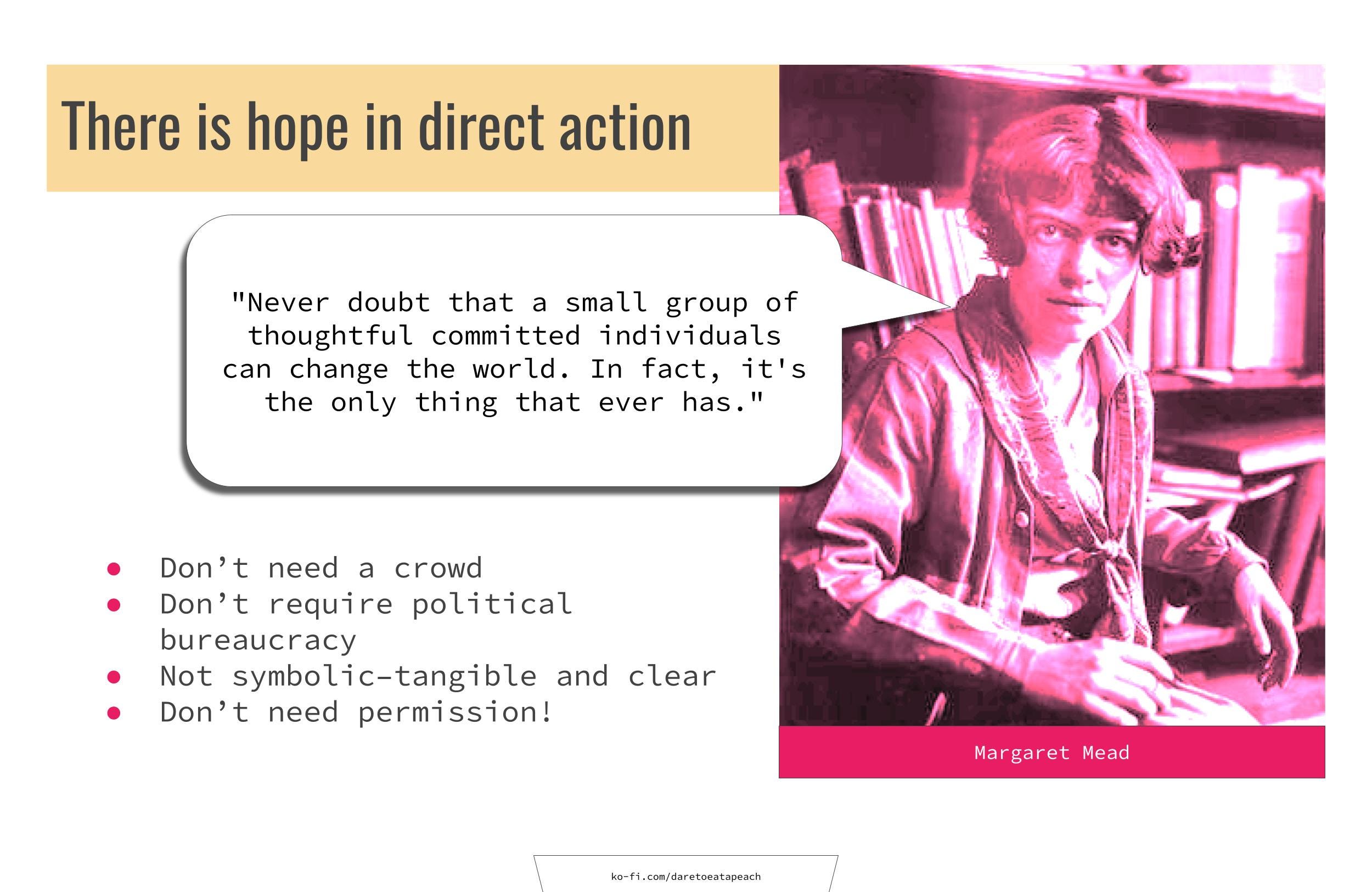
It’s easy to be cynical these days. If the largest marches in history could not bring change, what hope is there? But it doesn’t take thousands of people to successfully pull off a direct action protest. In most cases it can easily be done with under a hundred people. Even twenty devoted participants can make change, when that change is direct, rather than symbolic. Since the nature of direct action is to act, or to prevent others from action, it is more visible than marching. The public can more easily understand the intent of well-organized direct action, because the act itself is tied to the desired outcome. Direct action doesn’t rely on a middle man, such as a politician, to bring about change. No matter how much money the other side has, money is a symbol and therefore can never be more powerful than the power of the people.
So make your signs, attend your rallies, and march—but remember it is through direct action that most change comes about.
Print this Direct Action Flyer to Pass out at Protests:
What to Do When Marching Isn’t Enough Flyer
Succinct description of direct action that fits on one page, with a black and white graphic (for cheaper printing) featuring the Frederick Douglass quote, “power concedes nothing without demand.” Clicking will open the PDF, save it wherever you want and print copies to hand out at protests. It helps to have a conversation about direct action, and what next steps we can take beyond marching.
Editorial note: this has been revised from an article I first wrote for Subversas.com: “Direct Action: What to Do When Marching Isn’t Enough to Stop Injustice”
This is great, Karma. You know I heard Savio's speech in person and then followed him and Joan Baez into Sproul Hall. I was arrested along with 800 others. I was just going to write about it on the issue of free speech. They called it the Free Speech Movement, but that was so they could get the Young Republicans to join the coalition. It wasn't really about free speech, it was about the right to raise money for SNCC and CORE to support the civil rights movement in the South. By characterizing it as free speech, they may have gotten more support, but they also divided the student movement from the civil rights movement.
It's awesome to see you laying out these different strategies! This seems like a conversation a lot of people need to be having right now: What has worked before and what makes sense now?